
AI Six Layers Framework
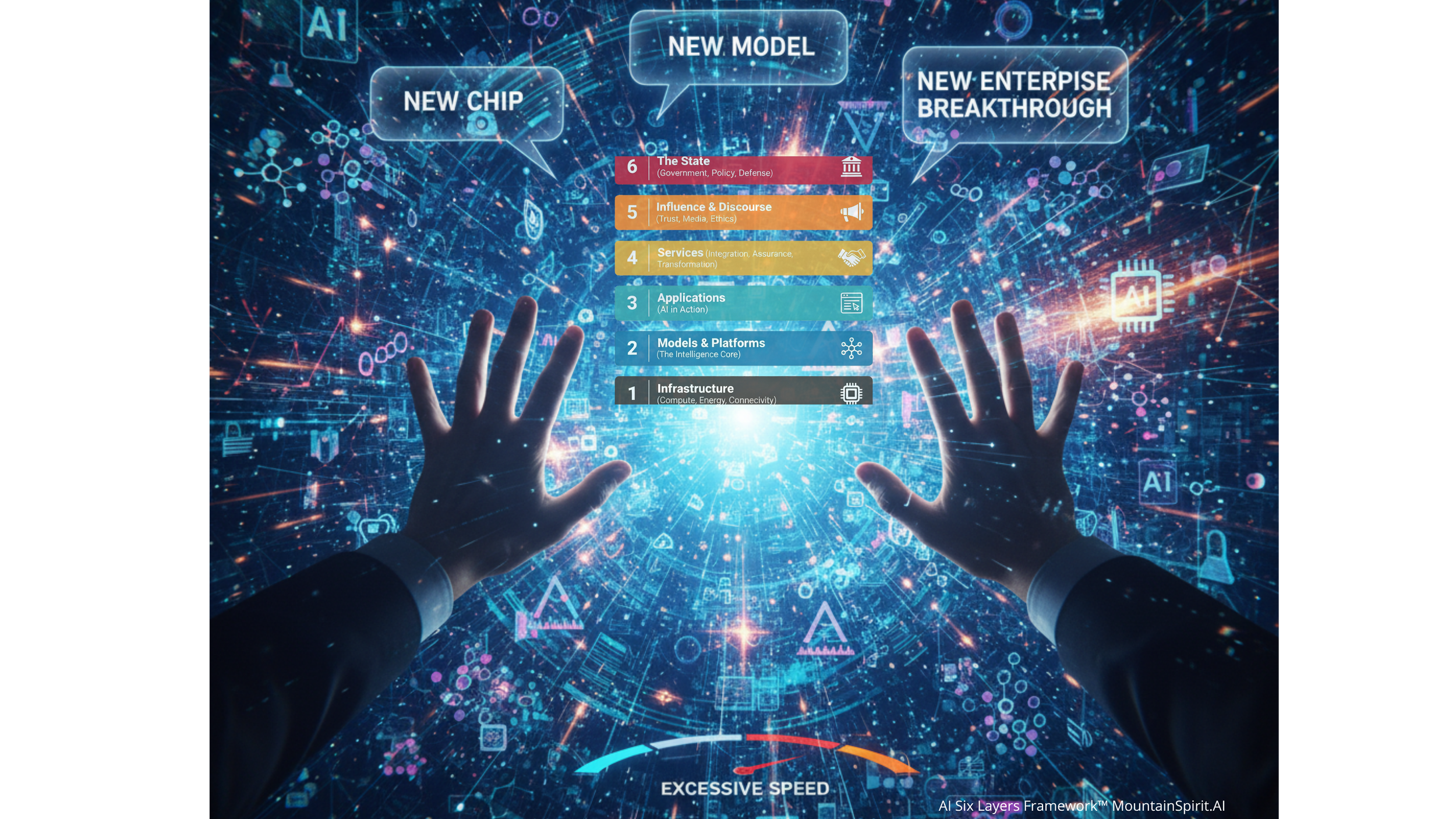
The MountainSpirit.AI Six Layers Framework™ is a simple map for seeing the whole AI landscape, not just the latest tools or models. It organizes AI into six connected layers so you can spot where you’re strong, where the gaps are, and what to focus on next.
The goal is to replace hype and confusion with a clear, practical way to talk about AI, make decisions, and plan real steps forward.
The Six Layers Overview
Infrastructure – Enables compute, storage, and connectivity. Strategic Insight: Power defines capability.
Models & Platforms – Transforms data into reasoning and capability. Strategic Insight: Governance shapes trust.
Applications – Converts intelligence into productivity and impact. Strategic Insight: Adoption defines success.
Services – Integrates AI safely and ethically into organizations. Strategic Insight: Human systems enable scale.
Influence & Discourse – Controls perception, legitimacy, and societal alignment. Strategic Insight: Story shapes legitimacy.
The State – Defines national priorities, regulation, and sovereignty. Strategic Insight: Sovereignty underpins safety.
This structure give leaders a clear picture of where they stand, whats possible, and how to move forward with confidence.
What Makes the Framework Unique
A clearer way to make sense of the AI ecosystem.
1.A Top-Down Strategic View
AI is more than tools or models — it’s a connected system.
The framework shows how infrastructure, models, applications, people, and governance all fit together, so you can see the whole picture and choose what truly matters.
Outcomes:
Better alignment across teams
Fewer wasted efforts
Clearer conversations with executives, vendors, and stakeholders.
2. A Shared Language for Teams
The biggest barrier to AI adoption is misunderstanding.
This framework gives leaders, technologists, and operators a common way to talk about AI without jargon.
Outcomes:
Simpler planning and strategy sessions
Faster agreement on priorities
Reduced confusion across departments.
3. A Mission-Focused Perspective
Most frameworks start with the tools. This one starts with the mission.
It focuses on decisions, outcomes, and readiness — ensuring AI supports real goals, values, and constraints.
Outcomes:
More responsible AI adoption
Stronger alignment to business or mission needs
Better long-term clarity.
4. Practical, Lightweight, and Usable
You don’t need a massive budget or technical team to use this model.
The AI Six Layers Framework™ works for organizations of any size — from enterprises to small businesses and public-sector teams.
Outcomes:
Clear next steps
Less overwhelm
A simple path to move forward

Decision Intelligence
Improving decisions, not just deploying tools
Decision Intelligence focuses on how people think, decide, and act using AI insights, structure, and data. It ensures that AI doesn’t overwhelm teams with complexity, but instead improves clarity, trust, and execution.
1. Start with Clarity
Good decisions begin with a shared understanding of:
The mission or business need
Who needs what information
When decisions must happen
Clarity removes noise so teams can focus on outcomes, not tools.
2. Appliy AI where it truly helps
AI should enhance human strengths — not replace them.
Use AI to improve:
Speed (faster answers, less friction)
Accuracy (better insight, fewer blind spots)
Workflow execution (automation where it makes sense)
This avoids the trap of “AI for AI’s sake.””
3. Build Trust and Close the Loop
People trust decisions when they trust the process.
Decision Intelligence includes:
Training and communication
Change management
Evaluation and refinement over time
This “closed loop” ensures AI continues to support good judgment and real-world constraints.
Better decisions → better outcomes → better organizations

Customer Orbit™
AI doesn’t exist in isolation — it responds to demand. The Customer Orbit explains the two-sided demand system that shapes how and why AI is adopted.
1. Humanity as the Global Customer (Macro Demand)
People create the fundamental demand for AI through their desire to:
Work more efficiently
Make better decisions
Reduce cognitive burden
Access knowledge
Improve quality of life
This is the human pull — the broad societal force accelerating AI adoption.
2. Organizations as the Paying Customer (Micro Demand)
Businesses, governments, and institutions create the operational and economic demand for AI as they seek to:
Improve productivity
Reduce cost
Innovate products and services
Make informed strategic decisions
Meet regulatory and governance expectations
This is the organizational pull — the direct, budget-driven adoption engine.
3. Why Customer Orbit Matters
When these two forces align — human need and business incentive — AI adoption accelerates. When they diverge — adoption slows, risk increases, and AI fails to deliver value.
Customer Orbit helps leaders answer:
Who is truly asking for this AI capability?
Does it serve real human needs, or only business pressures?
Does it support mission, value, and the workforce simultaneously?
This ensures AI is built for people, not just implemented for technology’s sake.
Outcome: Demand-Driven AI Adoption
Together, these three pillars help leaders see the whole landscape — where they stand, what matters, and how to move forward with confidence.