
How the Six Layers Framework Helps
The MountainSpirit.AI Six Layers Framework™ gives leaders a systems-level lens to solve today’s most pressing AI challenges—whether strategic, technical, ethical, or organizational. It maps the AI ecosystem from infrastructure and models to applications, services, influence, and policy, showing how power, trust, and value flow across each layer. By using this structure, leaders can pinpoint where problems originate, align solutions across departments, and design AI strategies that are scalable, secure, and ethically sound. Each of the Top 10 Challenges below will be explored in greater detail through dedicated briefings to help leaders take decisive, well-informed action.
Top 10 AI Challenges for Leadership in 2026
-
Formulating a Cohesive AI Strategy with ROI
Leaders are under pressure to move beyond ad-hoc AI experiments and embed AI into core strategy for tangible returns. The key question is how to align AI initiatives with business or mission objectives and define clear metrics for ROI and value creation.
-
Scaling AI Initiatives Enterprise-Wide
Progressing from successful pilot projects to broad enterprise adoption. Leaders grapple with how to “move beyond isolated AI experiments to enterprise-wide adoption,” including integrating AI into legacy systems and workflows.
-
Transforming Business Models with AI Innovation
Leaders are asking how AI can fundamentally transform their business or mission model for sustainable advantage. The focus is shifting from simply automating processes to using AI for new value propositions – for example, creating AI-driven products and services, personalizing customer experiences at scale, or even disrupting industry value chains. A majority of executives see AI as a catalyst for transformative innovation, not just efficiency; in one survey, high-performing companies were 3× more likely to pursue enterprise-wide transformation via AI (versus just cost cuts).
-
Addressing the AI Talent and Skills Gap
The shortage of AI-skilled talent has become a significant hurdle across both government and industry. “The lack of internal AI expertise is a significant barrier to adoption,” as one report noted. Leaders are struggling to attract, develop, and retain people with AI and data science skills in a highly competitive market. At the same time, they must upskill or reskill the existing workforce to be “AI literate” at all levels (from frontline staff to the C-suite).
-
Managing Workforce Transition and Human–AI Collaboration
Hand-in-hand with talent concerns is the challenge of how AI will reshape jobs, workflows, and organizational culture. Leaders must manage the transition to a workplace where humans and AI systems collaborate. There are widespread concerns about job displacement, role changes, and employee morale. Indeed, the impact of AI on jobs – both displacement and augmentation – is a primary concern for executives.
-
Building Robust Data Infrastructure and Governance
Successful AI depends on data – and many organizations are finding that their data foundations are not up to the task. Leaders ask, “Do we have the necessary data infrastructure and governance to support our AI ambitions?”. Common challenges include data quality issues, fragmented or siloed data across departments, and insufficient data to train AI models.
-
Ensuring Ethical and Responsible AI Use
As AI systems become more powerful and pervasive, leaders face intense scrutiny and ethical considerations. Top-of-mind issues include algorithmic bias, fairness, transparency, accountability, and compliance with emerging regulations. Executives are asking how to establish clear ethical guidelines and AI governance to prevent unintended harm and build public trust.
-
Mitigating AI-Related Security Risks
AI’s rapid adoption also introduces new security and cyber-risk challenges. Leaders worry that as they integrate AI into critical operations, the attack surface grows – from data breaches and model vulnerabilities to entirely new AI-powered threats. Notably, malicious actors can use AI for more sophisticated cyberattacks (e.g. AI-generated phishing or malware), and AI systems themselves may have exploitable flaws.
-
Establishing an Effective AI Operating Model
Implementing AI at scale often forces leaders to rethink their organization’s operating model and governance for technology. Executives recognize that “AI cannot be managed like traditional IT projects.”Unlike routine IT, AI initiatives cut across departments, iterate continuously, and carry unique risks. Thus, leaders are re-evaluating internal structures: Do we need a central AI Center of Excellence or AI governance board? How do we define new roles (e.g. AI product managers, data governance officers) and responsibilities? What’s the right balance between a centralized AI team (ensuring standards and efficiency) versus decentralizing AI capabilities into each business unit (for agility and innovation)?
-
Electing the Right AI Technologies and Partners
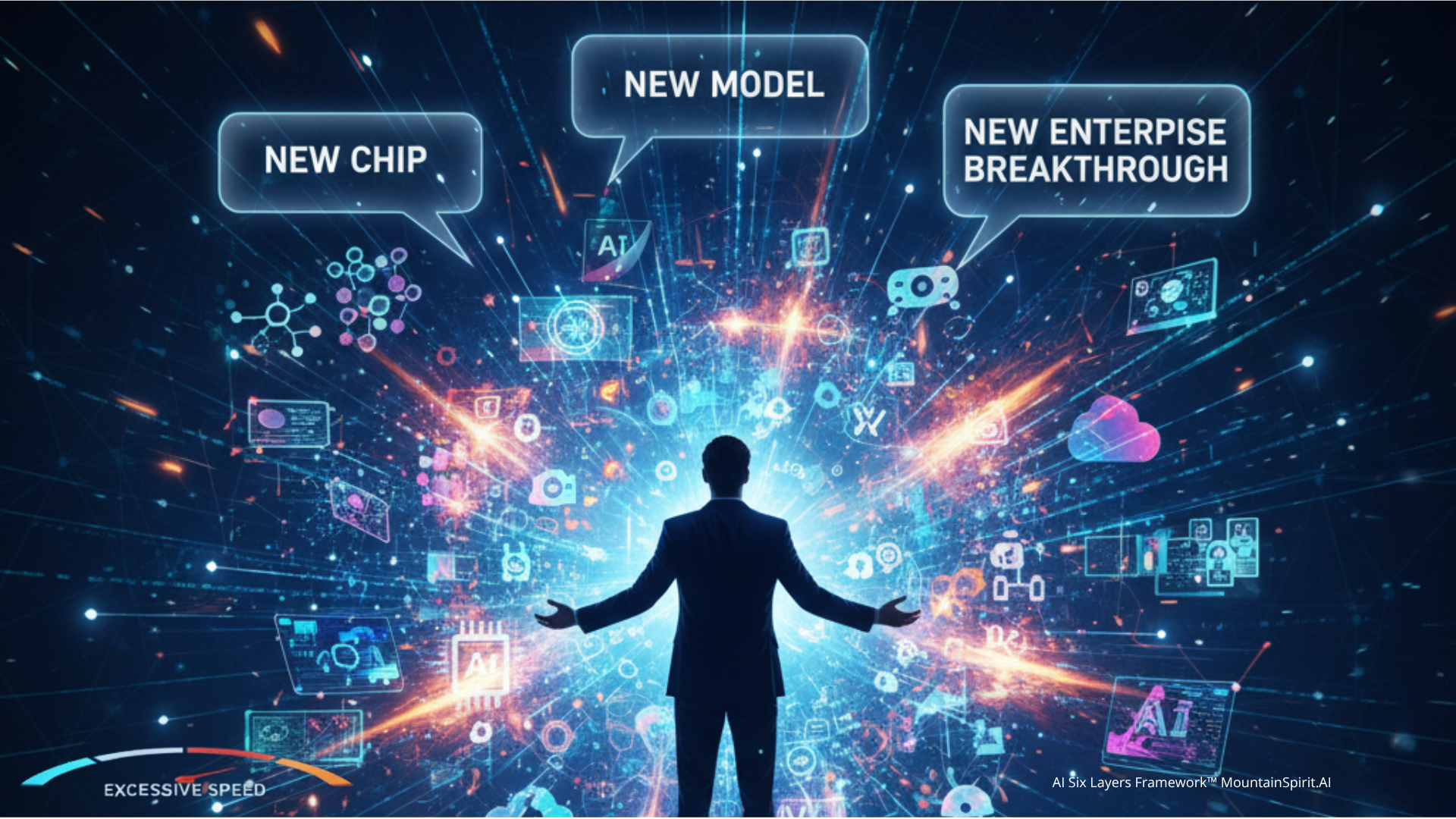
The AI ecosystem in late 2025 is extraordinarily dynamic – new models, tools, and vendors emerge continuously. Leaders struggle with technology selection and partnership decisions in this fast-changing landscape. Questions include: Build or buy? Should we develop proprietary AI models or use third-party platforms (e.g. from cloud providers or AI startups)? How do we choose among dozens of AI software tools for a given task? If we partner with vendors, how do we avoid vendor lock-in and ensure we retain control over our data and models?